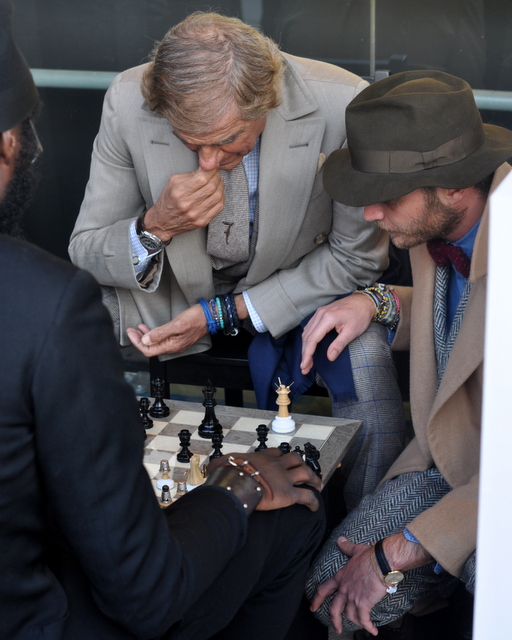
Grandmasters of Pitti Uomo playing a game of chess.
Notice Luca Rubinacci’s large herringbones and Lino Leluzzi’s bold blue overcheck. Do not underestimate the role of cloth and texture.
Source: The Journal of Style

Grandmasters of Pitti Uomo playing a game of chess.
Notice Luca Rubinacci’s large herringbones and Lino Leluzzi’s bold blue overcheck. Do not underestimate the role of cloth and texture.
Source: The Journal of Style
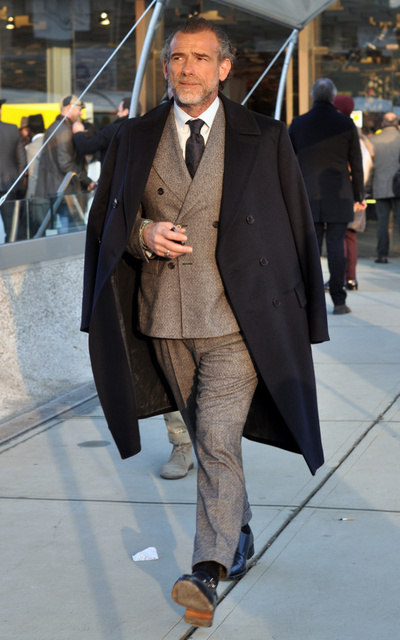
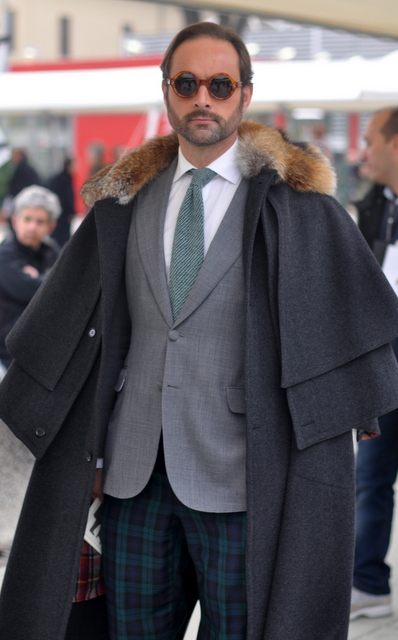
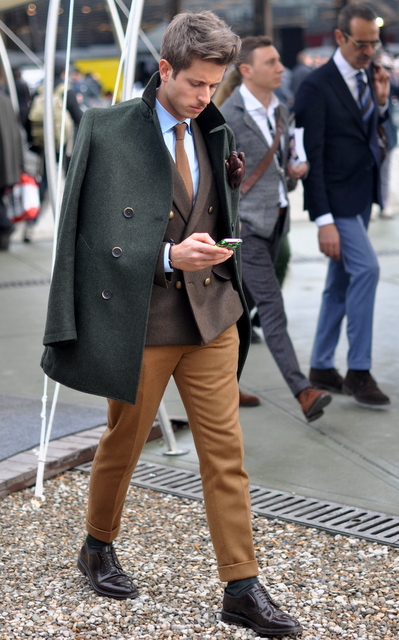
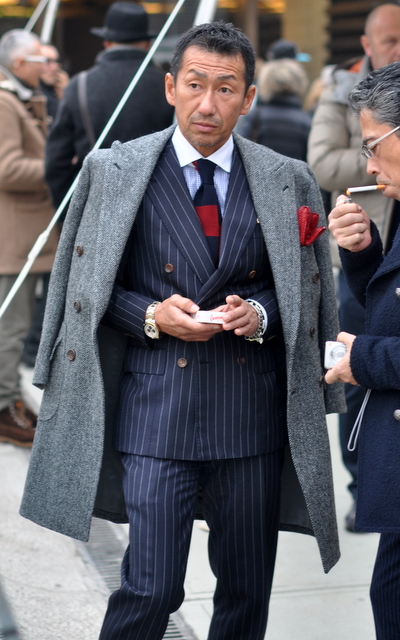
Pitti Uomo is fun. The menswear trade fair in Florence is a theater of style with good and bad acts.
Compared to the winter trade fair of last year, I didn’t identify significant changes. People could be wearing more tweeds and less flannel, but I am not sure about that. Boots were common, and so were monk strap shoes. The narrow cut was still there, however not as uniquely popular as before. People liked hats and colourful scarves. Lots and lots of grey and blue, including lighter shades like royal blue.
The wearing of overcoats as capes, which has a dramatic effect, is seen before too. But, the art of carrying it out is always a challenge. The gentleman in the upper photo does it quite well, doesn’t he?
Source: The Journal of Style
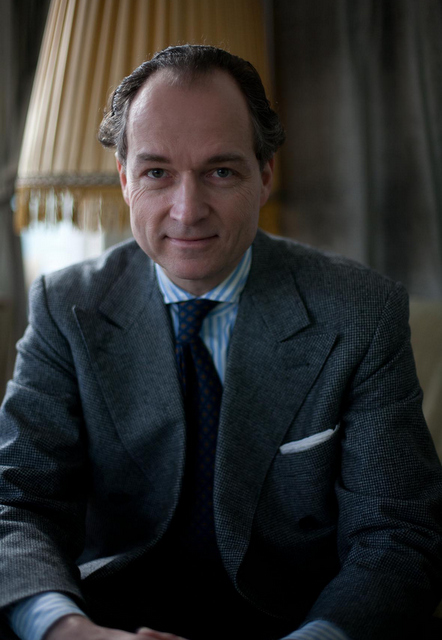
Not long ago Bernhard Roetzel, writer of Gentleman. A Timeless Fashion, published a new book on menswear, A Guy’s Guide to Style. I got it for Christmas, and I soon after felt like asking mr. Roetzel a few questions …
As a fan of Gentleman. A Timeless Fashion, your book from the 90s on classic clothing, I was astonished to read about flip flops, synthetic garments, printed jerseys, t-shirts and sneakers in A Guy’s Guide to Style. What has happened?
There is an article about flip flops in my new book but I don’t advise to wear them outside the beach. In a way my new book is an undercover approach to timeless fashion. It looks modern on the outside but it’s very conversative on the inside.
In the foreword of A Guy’s Guide to Style you mention that clothing, in general, has gotten more casual during the last 10 year. On the other hand, we witness a growing interest in bespoke clothing (if sales figures from Savile Row can represent the bespoke demand). How would you relate these two phenomenons?
Bespoke clothes are reserved for a very small minority of people, no matter how much the interest in this type of garments will grow. If sales in Savile are growing, it is because more wealthy people find out about the benefits of a bespoke suit. The majority of men are not interested in bespoke clothes at all. Even if they could afford it, they wouldn’t see the point of ordering a suit instead of buying something fashionable off the rack. But who cares? Bespoke clothes are not something for everbody.
I get the impression, when reading Gentleman and A Guy’s Guide to Style that conveying to certain established clothing norms, rules or dresscodes is a key to good dressing for you, not only in regard to classic dressing but also in regards to modern casual wear. How do you look at creativity and intuition, when it comes to dressing?
Only very few people rely on creativity and intuition when it comes to dressing. People want to show that they belong to a group. They don’t want to be eccentric. If you like the style that I explain in my book Gentleman, you will be eager to learn all the rules you need to know to master this style. If you prefer creativity, you will probably dress in a different way.
Photo: Bernhard Roetzel in a bespoke suit from Kathrin Emmer in Berlin
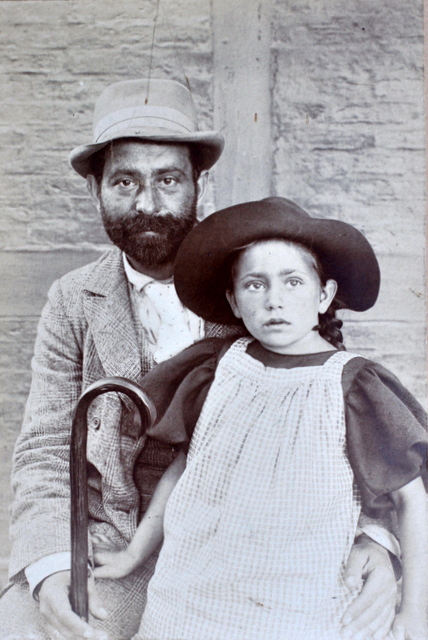
Theater director Emmanuel Larsen (in a prince of wales tweed) with his daughter.
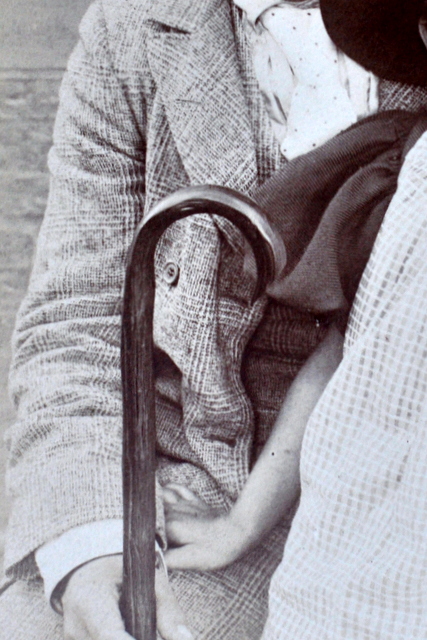
Looking at family photos hanging on a wall of my mom’s house, I rediscovered a portrait from 1898 of my great-great-grandfather and his daugther, my great-grandmother. A sartorial and historical detail captured me: the Prince of Wales tweed. The photo must be one of the oldest depicting the famous tweed clearly, certainly in Denmark.
The Prince of Wales cloth was first popularized in the late 19th Century by the Prince of Wales “Bertie”, the future Edward VII, and anew in the 1920s by his grandson David, who would be the Duke of Windsor. The Prince of Wales design is an adapted version of Glenurquhart Checks from Seafield Estate.
Source: The Journal of Style
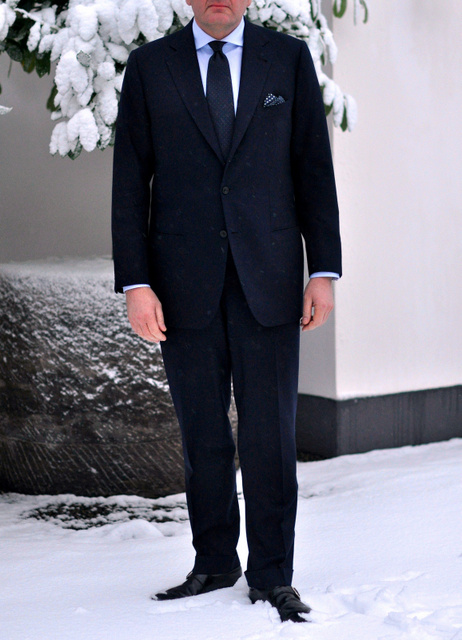
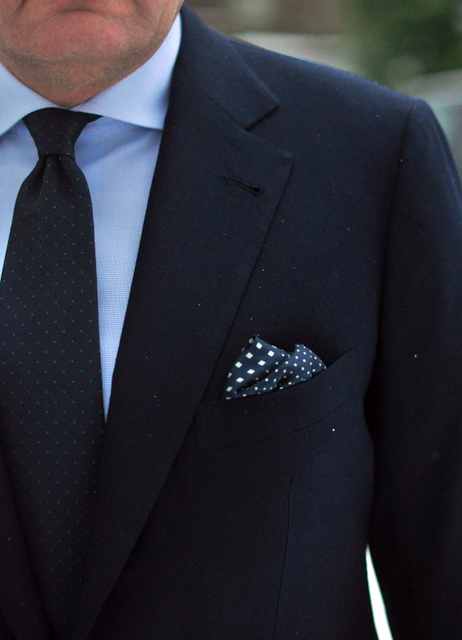
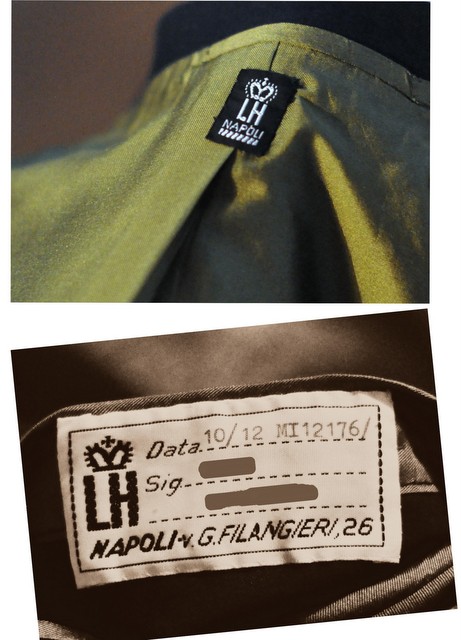
I have a feeling that Rubinacci now ranks at same level as Caraceni in terms of brand power outside Italy. Much better than A. Caraceni in Milan and Caraceni in Rome, Rubinacci has understood what to do with the internet.
Probably, the soft cut has made an impact too. It seems to fit the Zeitgeist better. We have been accustomed to casual wear for decades now, and soft tailoring is a sort of translation of the suit to our times.
The price level reflects the balance of power. A bespoke suit from Rubinacci is now 4.500 Euros, the costs of a bespoke suit from A. Caraceni.
Above, a Danish gentleman in a bespoke navy blue Rubinacci suit just arrived from the Milanese department.
Source: The Journal of Style